



The Vision
I wanted a network that functions like a professional data center but feels like a cozy home. This setup bridges the gap between massive local compute power (my AI Tower with RTX 5080) and the flexibility of working from anywhere in the world.
What I Built Now As The First Version
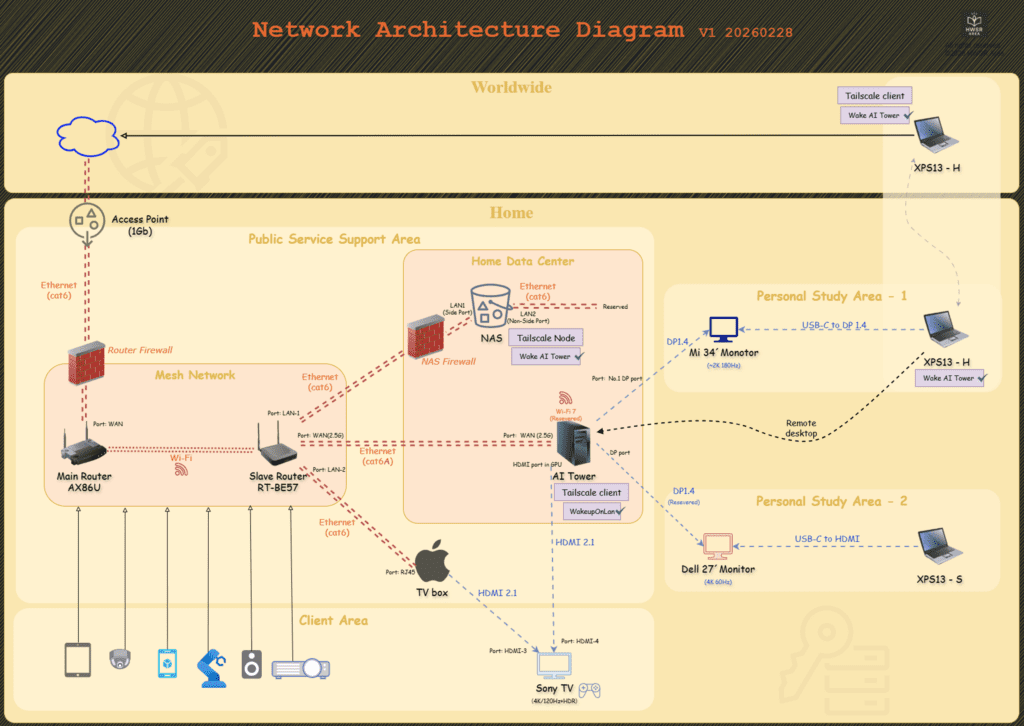
And several key points have already considered as following.
Secure-by-Design Connectivity
Security is not an afterthought but a foundational layer of this framework. To protect the integrity of my AI assets and personal data, I have implemented a hardened Zero Trust security posture. This includes:
- Encrypted P2P Tunneling: Utilizing Tailscale to create a private, invisible network overlay.
- Granular Access Control: Advanced ACL Grants and Tags that strictly isolate the AI Tower and NAS from unauthorized lateral movement.
- Segmented Firewalls: Multi-layered protection between public entry points and the Home Data Center.
Global Accessibility & Power Intelligence
The true power of this setup lies in its Worldwide reach. Whether I am in my study or traveling abroad, the architecture provides seamless remote access to my local environment.
To balance high-performance compute with energy efficiency, I integrated a remote Wake-on-LAN (WoL) gateway. This allows the Synology NAS to act as a secure intermediary, enabling me to “cold boot” the AI Tower from across the globe only when heavy lifting is required.
The Philosophy: Maximum Utility from Premium Hardware
The blueprint for my home network was driven by a single objective: to extract every ounce of performance from my current hardware ecosystem. By strategically deploying 2.5G backhaul via Cat 6A cabling specifically for the AI Tower (RTX 5080), I eliminated data bottlenecks while maintaining a streamlined Cat 6 environment for the rest of the home. Similarly, the physical layer is optimized for high-fidelity visualization, utilizing HDMI 2.1 to bridge the gap between AI-driven rendering and premium display output.
Summary
By focusing on resource optimization, layered security, and intelligent remote management, I have transformed a collection of hardware into a unified, secure, and globally accessible AI powerhouse.